Showing posts with label author interview. Show all posts

Thursday, 17 October 2019

BOOK BLOG TOUR FOR MOTHER TONGUE BY PATRICIA FORDE


MY BOOK BLOG FOR MOTHER TONGUE BY PATRICIA FORDE ABOUT WORLD BUILDING


MOTHER TONGUE SYNOPSIS

After global warming came the Melting. Then came Ark.

The new dictator of Ark wants to silence speech for ever. But Letta is the wordsmith, tasked with keeping words alive. Out in the woods, she and the rebels secretly teach children language, music and art.
Now there are rumours that babies are going missing. When Letta makes a horrifying discovery, she has to find a way to save the children of Ark – even if it is at the cost of her own life.
Mother Tongue is the new speculative middle-grade climate fiction from the award-winning author of The Wordsmith, winner of a White Raven award and a Library Association of America Notable Book.


A fascinating insight into World Building with author Patricia Forde. 

In writing terms, world building is the process of inventing an imaginary world. I had my first experience of inventing a new world when I was about seven. My five sisters and I took turns at washing the dishes after dinner each night. My job was to dry the cutlery and replace it in the cutlery drawer. Over time, I found ways to amuse myself as I worked. I imagined that I was dealing with families: the Knife family, the Fork family and the Spoon family. Teaspoons were neutral. They were babies and could go into any family. Soon I was playing elaborate games of make believe with the cutlery. I made houses for them and had had them visit one another. I decided that the Forks were cantankerous and that the children in the other families were afraid of them. Without ever knowing that such a skill existed I had started to world build.
Later, I used the same technique with a pack of cards. Now the families were the Hearts, Diamonds, Spades and Clubs. And the children had ages! The ten of clubs could play with the ten of hearts but they ran away when the young three of spades tried to join in. The mammies would get together to do the shopping while the dads went out to work. (Odd, given my own mother worked!) As I got older, the stories became more elaborate, rules were made, punishments invented for those who broke the rules and in my head these imaginary worlds streamed past all borders until even I couldn’t see where they ended.
Inventing Ark, the land ruled by John Noa after the climate-change catastophe known as the Melting, whilst writing The Wordsmith and later Mother Tongue was the most enjoyable part of the work for me. I gave Ark a history. I did a timeline from our time to where the story starts. I had to know, for example, what age Noa was when the final catastrophes happened, in order to make the timeline believable. I had to imagine what the end had looked like, the panic as people fled from the rising water. I had to think about the geography of Ark. I drew maps showing key places to keep me grounded as I wrote. I thought about religion. There is a statue of The Goddess in Ark. We discover that she was actually a prophet sent to warn people about human cloning. In my head there was a long and complex story about the religions of Ark, what people believed in and why. John Noa didn’t believe in an afterlife. He said that only mankind would be arrogant enough to believe that death wasn’t the end.
I love historical fiction and as the story took place after the Melting had happened it felt more like going back in time. Global warming had caused the Earth to heat up, the seas to rise and all technology had been drowned.
 We were back in a time before computers, before phones, before the industrial age. In Ark you find shoemakers and tanners alongside farmers and cooks.
This dystopian future was a simpler place in many ways but also has some new ideas. There is, for example, Central Kitchen. People are not allowed to cook for themselves. It’s less wasteful, and more energy efficient, to have all the cooking done in one location. People eat what is in season and they eat what they are given or they starve. No citizen of Ark gets to choose what they eat. That too is done centrally. I found that idea quite abhorrent. I love food and I love to cook. I believe it’s a basic human right to be allowed to cook your own food.
In Mother Tongue we move out into the forest that surrounds Ark with its rebel camps, wild animals and strange atmosphere. This was a different type of world building. Here I had to think about the life of an outlaw. What it’s like to live on the edge of a society. I drew a map of the forest and studied different flora and fauna, though much of the research didn’t make it into the book.
And then there is the question of language. In any fantastical world you need to interrogate language. Is there more than one language, more than one dialect? In Ark, there are people who are fluent, people who are wordless, and in between there are those who survive on just five hundred words. Even within that last subset, there are people who speak beautifully, like Mrs Truckle, and many who sound ‘rusty’ to Letta’s well-tuned ear.
History, geography, religion, class, money, language and power. All of these things are elements of world building. They say you should never see how a sausage is made or how a law is made. I think they could add world building to the list. Whereas the writer needs to know a lot about a newly invented world, the reader doesn't need a massive amount of detail. They don’t need to be deluged with information and back story. Readers can hugely enjoy the experience of the world (think of The Hobbit or The Borrowers) but really they want to have an emotional reaction to the story. This reaction comes primarily from the reader’s relationship with the characters.
When it comes to constructing a world, I think the reader needs vivid details, suggestions and well-placed clues. They do the rest of the work for themselves.
World building can be a stressful occupation for a writer and it is fraught with difficulties but when I am about to imagine a new world I like to think of what Bilbo Baggins once said:
“It’s a dangerous business, Frodo, going out of your door. You step into the Road, and if you don’t keep your feet, there is no knowing where you might be swept off to.” –Bilbo Baggins

Patricia Forde

Patricia Forde is from Galway, on the west coast of Ireland. Her first novel The Wordsmith was published to great critical acclaim in 2015. It has since been published in the United States, Australia, Denmark, Russia, Turkey and the Netherlands. It has won a White Raven Award from the International Youth Library, is an American Library Association Notable Book for Children in the United States, and was shortlisted for the Children’s Book of the Year Award in Ireland. In 2018 Patricia wrote Bumpfizzle the Best on Planet Earth, which was chosen as the Dublin UNESCO Citywide Read 2019.


MY BOOK REVIEW FOR MOTHER TONGUE BY PATRICIA FORDE
CHILDREN 10+
After global warming, the new order wants to silence speech forever. Letta is a wordsmith and rebel, teaching children language, music and art. But when babies start to go missing, she must find a way to save them. This taut dystopian thriller has a strong environmental message at its heart. It also questions the balance between political power and corruption. This vivid world and courageous heroine will enthral readers and is ideal for book clubs.
PB Little Island £7.99
5/5 Stars


Monday, 3 September 2018

BLOG TOUR STORM WITCH BY ELLEN RENNER SEPT 3RD


BLOG TOUR FOR STORM WITCH BY ELLEN RENNER 

I was thrilled to interview Ellen  about her new middle grade magical adventure, Storm Witch. Read about her book and her life as an author below.


Describe Storm Witch in one sentence.
It’s a coming-of-age story set in a world of vast seas and small islands; where Storm has to discover who she is while struggling with elemental magic, love and loss, friendship and betrayal.

(So the answer is: only if it’s a really long sentence!)


What inspired the powerful elemental element in the book?

I’ve wanted to write a book about weather magic for a long time. But magic is dangerous – the logic has to be impeccable or you will make yourself ridiculous. If I use magic I want it to be connected to the themes of the book – the ‘why?’.

For Storm Witch it made sense to use the ancient concept of four elements – air, earth, fire and water – and make the elements themselves the source of Storm’s power. The Elementals are at war, and that could destroy Storm’s world. Storm Witch is ultimately about ‘balance’ – the creative versus the destructive urge in human beings. It’s about how hard it is for all of us to find that balance, individually and as a society; and equally how essential it is that we keep trying.

What is your favourite part of the book?


Probably Storm’s ‘Choosing’, where she has to travel alone to the top of her island’s mountain (a dormant volcano) and visit the shrines of the Elementals one by one, to hear their prophecies. It was great fun to write.

What character do you most relate to?


There are two: Storm and her mother, Dain. But all my characters will have something of me in them. Scary, when I think of a few of my villains . . .


Can we have a sneaky clue to what is in store for Storm in the rest of the series?

Of course not: that would spoil the fun. And my editor would be unhappy. She’s very nice and extremely talented, and I want her to be happy.


As a professional writer what has most surprised you that you didn't expect?

That each book is just as hard, sometimes harder, than the last. I guess you keep raising the bar, but I somehow thought it would get easier. It’s also a surprise (and relief!) that the more I write, the more my imagination flourishes – like a garden constantly sprouting weird and wonderful new plants. I’ve no idea where it all comes from, especially my casts of characters.

What's a typical writing day for you?

I get up at around 7-ish and go to my study. I start with a cup of tea and a read-through of the previous day’s work, to get me into the story again. Then I get some music going and try to get a few hundred words down before breakfast, even if they’re rubbish and I’m not feeling it. I take breaks to make fresh tea or eat something. Music is essential, or an app with white noise like Ommwriter. When I hit a dead end, I’ll knit or play the piano for fifteen minutes to refresh.

I’m a morning person; by late-afternoon my brain is done and I start doing non-writing jobs. When the weather is good I take a motorcycle for a run up a twisty road. Riding is a necessary counterpoint to the writing and a great stress reliever. It’s active instead of sedentary, and it’s like meditation: you need to be totally in the moment and concentrating. The other thing I like to do is get to the gym three evenings a week. I need a certain level of fitness to stay well and focussed both for the writing and the motorcycles.

For me the key is starting first thing. If I let myself be distracted I can procrastinate for hours, doing all those other terribly important jobs that always need doing.

First drafts are mentally and emotionally challenging so I can only do about four to five hours a day, although I can rewrite all day long. I prefer rewriting to first drafting. Rewriting is creative in a different way; it’s where books are made. First drafts can be like pulling teeth. I’m a seat-of-the-pantser: I can’t plot in detail in advance and have given up trying.

One of my books, City of Thieves, wrote itself, and the first draft barely needed any rewriting. That hasn’t happened since, although I wish it would. That really was magic!


Who is your favourite literary hero or heroine?

Difficult question. I’m not sure I can claim to have a favourite, but I am very fond of Cat Chant from Diana Wynne Jones’ Charmed Life. I like his diffidence and cowardice. True bravery is all about being frightened 

Storm Witch by Ellen Renner is published on 6th September by Nosy Crow in paperback priced £6.99


MANY THANKS TO ELLEN FOR HER FASCINATING INTERVIEW. FIND MORE INFO ABOUT THE AUTHOR AND BOOK ON TWITTER @Ellen_Renner


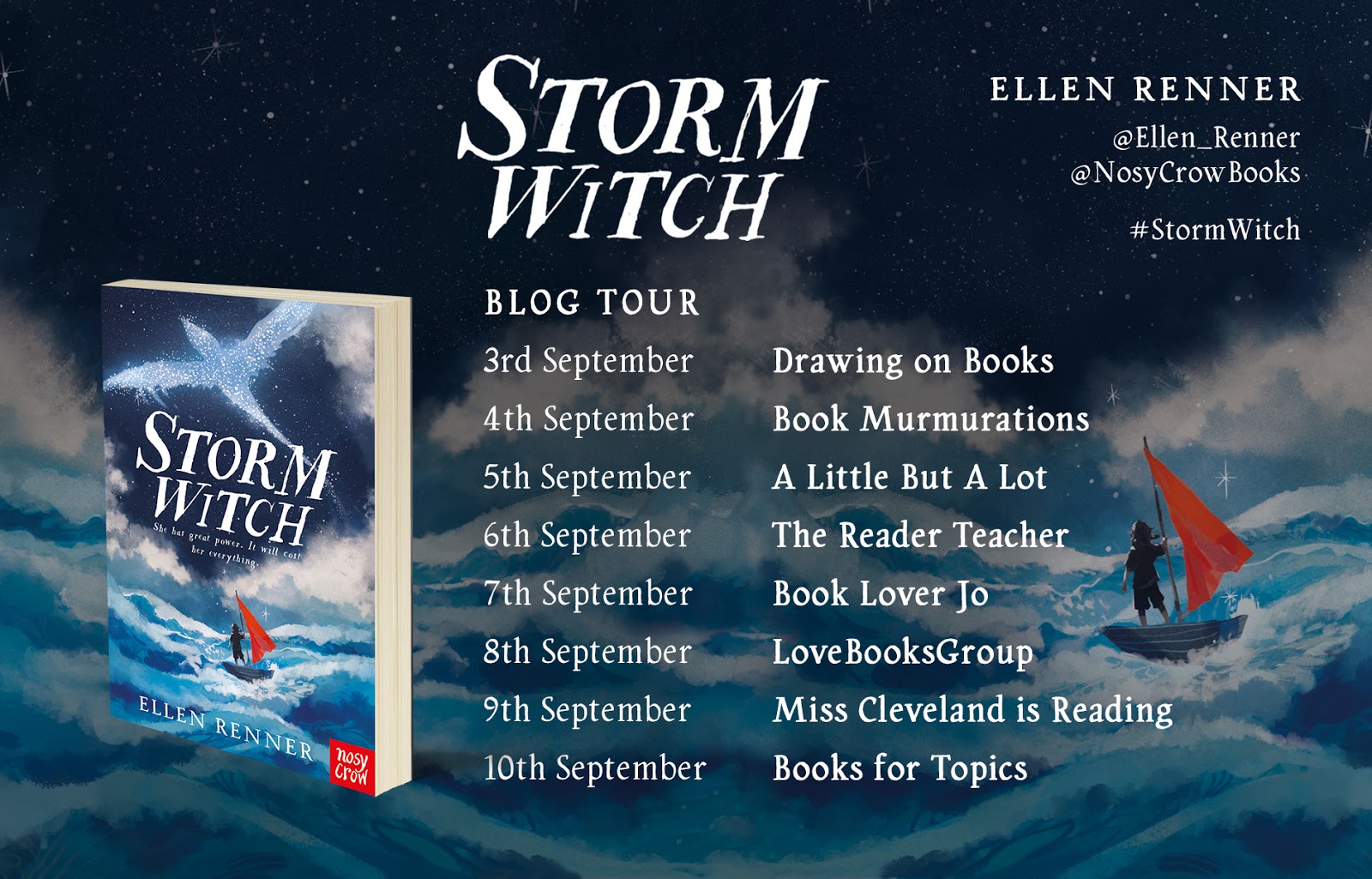
If you wish to follow the rest of the Blog tour  see the banner below


MY REVIEW OF STORM WITCH BY ELLEN RENNER
CHILDREN 9+
Thirteen-year-old Storm must undertake The Choosing and be claimed by one of the Elementals, Air, Water, Earth or Fire. But she is bestowed with a great and terrible gift. Will Storm's new powers help save those she loves or will it betray everything she holds dear? A whirlwind adventure which will sweep you into its enchanted world. At its epicentre is a strong heroine in a coming of age quest that will leave you breathless.
ISBN 9780857636409 PB Nosy Crow £6.99


Friday, 3 August 2018

BLOG TOUR KNIGHTS AND BIKES BY GABRIELLE KENT AUG3RD


BLOG TOUR FOR KNIGHTS AND BIKES BY GABRIELLE KENT. 

I was thrilled to interview Gabrielle about her new middle grade book, Knights and Bikes. Read about her book and her life as an author below.


Can you describe your book Knights and Bikes in once sentence.

An action packed adventure set in the 1980s following two bike-riding, fun loving heroines and a pet goose as they search for the fabled treasure of the Penfurzy knights as a curse creeps across the island.

What inspired you to write this book?

I was asked to write this book to tie in with the videogame. I decided to do it because the characters are all brilliant and so much fun to write.

What is your favourite part of the book?

The first chapter when Nessa meets Demelza and Captain Honkers. It also involves a very gross handshake that I'm proud of.

What character do you most relate to?

I'd love to be as cool as Nessa, but I very much relate to Demelza. I was a socially awkward, comics reading, videogame playing, art loving kid who was always putting my foot in my mouth and charging headfirst into potential adventures without thinking. I didn't have a pet goose, but I was often chased by the geese on my granny's farm.

Are you working on your next book? Can we have a sneaky clue to what's it about?

I'm working on a book featuring a British Asian Girl and her Mauritian grandma who follow a treasure trail to solve a mystery in an attempt to win a very valuable prize.

As a professional writer what has most surprised you that you didn't expect?

Fan letters! It's so strange and utterly lovely to hear how much someone loves the characters and worlds you have created.

What's a typical writing day for you?

I haven't had a whole day to write since my daughter was born. I can only write when she is sleeping, so I squeeze it in between feeding and cleaning her, playing games, singing silly songs and chasing her around the living room trying to put a nappy on her.

Who is your favourite literary hero or heroine?

Granny Weatherwax from Terry Pratchett's Discworld series – an incredibly powerful and stubborn witch.

Which is your favourite bookshop?

The Book Corner in Saltburn. It's a lovely little shop with a very friendly owner and in close proximity to excellent fish and chips.

Your favourite quote?

"The space between the young readers' eyeballs and the printed page is a holy place, and officialdom should trample all over it at their peril." Sir Terry Pratchett

MANY THANKS TO GABRIELLE FOR HER FASCINATING INTERVIEW. FIND MORE INFO ABOUT THE AUTHOR AND BOOK ON TWITTER @_KnightsOf @GabrielleKent and #KnightsandBikes 

KNIGHTS AND BIKES BY GABRIELLE KENT
CHILDREN 9+
Knights and Bikes is based on the video game of the same name. Set on a Cornish island in the 1980’s, Knights and Bikes follows the story of new best friends Demelza and Nessa as they explore the island on their trusty two wheeled steeds to uncover the cursed treasure of the Penfurzy Knights.

Monday, 11 June 2018

MIRROR MAGIC BLOG TOUR JULY 11th

Mirror Magic Blog Tour June 10th 


My interview with Claire for my blog Drawing on Books

Can you describe your book Mirror Magic in one sentence?
A pair of Victorian orphan siblings return to their birthplace of Wyse – the only town in Britain where magic still works…

Where did your idea for Mirror Magic come from?
It started with a conversation with my agent. The BBC adaptation of Jonathan Strange and Mr Norrel had just been on TV and she said she’d love to see a middle grade version. I, in my usual fashion of opening my mouth without thinking, said 'I can do that!’
Of course once I started to write, it became a very different thing. I drew inspiration from Victorian gothic novels and my favourite Dr Who episodes, which have humour and creepiness in equal measure.

What is your favourite part of the book?
It’s near the end, so I won’t spoil it for you. But I love the twin towns of Wyse and Unwyse and the way magic has been downgraded to a tourist attraction so that no one takes it seriously – until it starts to go wrong.


Who is your favourite character? or Which character do you most relate to?
The Book. I used chapter headings in my last two books (The Accidental Pirates series) and this time I decided to turn the author of the chapter headings into a character. And so I have a sarcastic, grumpy magical book which has a habit of making random, nonsensical pronouncements. It’s basically me before I’ve had my morning pot of tea.


As a professional writer what has surprised you most that you didn't expect?
The joy of working with an editor. The back and forth with someone who can see the potential of your book and is determined to bring it out, despite your incompetent writing. I hadn’t appreciated how much work an editor puts into a book before. It’s immensely satisfying to see a story take shape over several rounds of editing. A good editor will push you beyond your capabilities and make you a better writer.


What is a typical writing day for you?
Small goals is what works for me. For a 55,000 word book, I set a large number of tiny goals – write 500 words, edit a scene that isn’t working, sort out a character’s background. I have a weekly to-do list with space to tick off tasks as I do them to give me a sense of achievement.
I usually sit down to start writing by nine o’clock. Sometimes I work at home and sometimes I meet a friend in a very nice café half an hour from home, which also helps me get a bit of exercise in before I start work. I write for two or three hours at a stretch and I try to remember to take a lunch break.
My word count for the day varies wildly. I aim at 2,000 words, sometimes I go way over and I can celebrate, on other days I struggle and end up deleting more words than I write but as long as I can keep ticking off goals in my notebook I know I’m heading in the right direction.

What is your favourite quote?
It comes from Reverend Stowe. He’s the Wyse vicar in Mirror Magic, and a member of Freedom For Fair Folk which campaigns for fairy rights. “Some people fear the unknown,” he says, “but in the end it’s always better to be shaped by our kindness than our fear.”
That, to me, is the heart of the book, as we live in an uncertain and frightening world, and fear can drive us to act very unkindly. Far better to be shaped by our kindness.

Who is your favourite literary hero or heroine
The recent BBC adaptation of The Woman in White has reminded me how much I like Marian Halcombe. She’s not conventionally beautiful – Wilkie Collins describes her as ugly – but she’s clever, brave and utterly terrific. She can face down evil men, climb about rooftops at night, play chess and argue politics. She could easily have been jealous of her pretty sister, but she loves Laura fiercely and will sacrifice anything to protect her. An all-round brilliant woman.

Are you working on your next book and if so can we have a sneaky clue what it's about?

I thought you’d never ask! My next book is called Storm Hound and it is my favourite book in the world (that’s probably just because I’m in the middle of writing it.) Storm is the youngest hound of Odin’s Wild Hunt – the hounds of Annwn, as they’re called in Wales. Unable to keep up with the pack, he crashlands just outside Abergavenny and is horrified to find he has shrunk to the size of a mortal puppy. He’s rescued and adopted by a family who have problems of their own, but Storm’s fall has been noticed, and soon the little Welsh town is filling up with strange people seeking to steal the stormhound’s magic.

There’s a sneak preview of Storm Hound at the back of Mirror Magic, and it’s coming out early next year, so you won’t have too long to wait.

Thank you Claire for a fascinating interview. Mirror Magic is my Book of the Week in the South Wales Evening Post. Review below. 

BOOK OF THE WEEK
MIRROR MAGIC BY CLAIRE FAYERS
CHILDREN 9+

Orphans Ava and her brother move to Wyse, set between England and Wales, and are catapulted into an ancient mystery. Wyse connects to the magical Unworld through mirrors. But why is the magic disappearing? In this Victorian adventure, Ava joins forces with a fairy, Howell, to protect a magic book of prophecy that could save them all. The charismatic cast of characters, creepy skeletons, enchanted hats and a snappy dog will keep young readers spellbound.
ISBN 9781509870066 PB Macmillan £6.99
5/5 Stars


Claire’s bio:

Claire Fayers was born and brought up in South Wales, an area of the country sadly deficient in dragons. Having studied English at University of Kent, Canterbury, she built a successful career writing short stories for women's magazines until the lure of magic became too much and she wrote The Accidental Pirates: Voyage to Magical North. It was selected for Waterstones Book of the Month and shortlisted for the FCBG Children's Book Award 2016, and its sequel, The Accidental Pirates: Journey to Dragon Island, was published in 2017. When she's not writing, you'll find Claire at her allotment. Mirror Magic is her third book with Macmillan Children's Books.


Claire’s links:

Twitter: @ClaireFayers
Facebook: /clairefayersauthor
http://clairefayers.com


Thursday, 10 May 2018

Blog Tour for Night of the Party by Tracey Mathias


DRAWING ON BOOKS BLOG TOUR :

NIGHT OF THE PARTY

BY TRACEY MATHIAS


I INTERVIEWED TRACEY ABOUT HER NOVEL NIGHT OF THE PARTY AND HER LIFE AS AN AUTHOR 


NIGHT OF THE PARTY is a political thriller and love story for teens, set in a dystopian, near-future England that’s governed by a hard right, ultra nationalist party.


Was there any particular incident during the build up to or during Brexit that inspired the politics in Night of the Party?

There wasn't a single specific incident; it was more a matter of picking up on general political trends at the time when I was developing the characters and plot of the novel, in late 2014 and early 2015. This was in the run up to the General Election of 2015 when UKIP was becoming increasingly vocal, picking up support in the polls, and even winning a couple of Parliamentary seats as the result of defections from the Eurosceptic wing of the Tory party. The Party in the book really resulted from imagining the most extreme version of that kind of nationalist, anti-immigration agenda that I could. The dystopian politics of the novel were fully formed, and most of the details worked out, before I'd even heard the word Brexit, and long before the EU referendum. What's been eerie has been to see how aspects of that world have been mirrored in real life in the last couple of years; most recently, of course, with the Windrush scandal.

What's your favourite part of Night of the Party? 

I like the Sophie scenes, in both Ash and Zara's memories. Partly because they reach back to a happier time that's less shadowed by both grief and danger, partly because Sophie is probably my favourite character in the book. And the sense of light and lightness in those scenes also made them enjoyable to write. 

Which character do you most identify with?

Ash (though I can't do maths or run to save my life). But I was rather like him as a teenager: academically ambitious, rather serious, very focussed on getting to Uni, a bit too well behaved. And we share a defining experience, although the details are very different: I had also lost a sister, and was my parents' only surviving child.


Do you hope to inspire teens to become more engaged in politics?

It's obviously a key theme of the book that politics has concrete effects on individual lives. So I would certainly hope that readers would be prompted to think about how politics affects them and others. In particular the novel raises issues surrounding people's rights to move across borders, and the status and treatment of people who find themselves (for whatever reason) living somewhere other than where they were born – questions which have a sharp and immediate relevance now in the wake of political developments that I didn't predict when I started to write: the hostile environment, the Windrush scandal, and the impact of Brexit on the status of EU citizens in the UK.


Why did you want to become a writer and has anything surprised you about being a professional writer that you didn't expect? 

As a child I was a bookworm and a daydreamer; I scribbled stories, and typed them on my Dad's heavy typewriter (on pink paper, for some reason that I can't now remember). Throughout my childhood, I dreamed of being a writer when I grew up, then I stopped writing when I started doing English A level, cowed by the brilliance of what I was reading. But the ambition to write never entirely went away, and when my youngest daughter started school I happened to come up with an idea for a story for children – which became my first fantasy novel. I suppose one thing that's surprised me about being a professional writer is how full of ups and downs the journey has been. That first novel was published in Germany in 2009 but it's taken many setbacks and another nine years to get to my UK debut.  

What is a typical writing day for you? 

I'm not sure there is such a thing...! But I'm definitely better in the mornings than the afternoons; if I don't get some work done before midday the day is likely to be a write off (sorry, I didn't intend that pun but I'm letting it stand.). Sometimes I work at home: early, at my desk, later, on the sofa; sometimes at the kitchen table, sometimes in the garden. But I also sometimes meet up with other writers and work alongside them for solidarity and company.

Are you working on your next book and if so can we have a sneaky clue what it's about?

It's at a VERY early stage: I have a couple of characters and a setting in my head, and a very loose sketch of the plot, and that's about all! It will have some things in common with Night of the Party: it will be set in a world that resembles but isn't quite real life, and will look at how individual lives are changed by the bigger context in which they exist.

Who is your favourite literary hero or heroine? 

Too many to choose from! But reading Middlemarch for the first time at eighteen was one of the great moments of my life and I still feel a strong affinity with Dorothea Brooke (also too serious and well behaved).


Which is your favourite bookshop? 

My all-time favourite bookshop has gone now. It was an indie at the top of the street where I live. The interior was long and narrow, and they'd added a gallery half way up the wall to increase the shelf space. It was a shop run for and by book lovers; on at least one occasion I went in to find the assistants reading out loud to one another from their latest favourite book. It was driven out of business when one of the chains opened in the local shopping centre. Nothing has quite replaced that for me, though I do enjoy the London Review of Books shop in Bloomsbury. It has such a comprehensive range of books that it always makes me feel totally under-read, but the café has brilliant cakes which help to compensate for the sense of literary inadequacy...


What's your favourite quote?

Again, too many to choose from. But I do love the lines from Little Gidding that I used in Night of the Party:


We shall not cease from exploration

And the end of all our exploring

Will be to arrive where we first started.


Thank you to Tracey and Scholastic for inviting me to be part of the blog tour. You can follow them on #NightoftheParty #StopTheParty @traceymathias @scholasticuk

About : Tracey Matthias is writer-in-residence at the DaCapo Music Foundation. She previously taught at a sixth form college and worked for the British Council on international development projects. Political thriller,